Menovky

utorok 7. júla 2015

Istanbul Museum Pass

What Is the Istanbul Museum Pass, and Should I Get One?

Picture of the Museum Pass Istanbul, a card providing easy access to famous sightseeing spots.

Is the Museum Pass Istanbul something I should apply for? I get this question a lot from people planning to visit the Turkish metropolitan. Unfortunately, there is no straightforward answer to this question.
It all depends on what you plan to visit and/or whether you mind standing (for a long time) in a queue or not. So let me explain what the Istanbul Museum Pass is, what you can (not) do with it, whether it’s right for you, and how you can get one.

What Is the Istanbul Museum Pass?

The Museum Pass is a one-time payment card that provides you access to historical museums and cultural points of interest in Istanbul. There are two types (see below). Both are valid for a certain amount of days, starting from the moment you first use it (not the moment you bought it).

Is the MüzeKart the same as the Museum Pass?

No. The Turkish Culture and Tourism Ministry introduced the MüzeKart in 2008. It was, and still is, a huge success among Turkish citizens. It also drew the attention of tourists, but they were (and are) not allowed to buy one. This outcry resulted in the creation of a separate card, the Museum Pass Istanbul.
The MüzeKart is valid for 300+ museums nationwide. Only Turkish nationals and foreigners with a residence permit can obtain it.
The Museum Pass Istanbul is for tourists visiting the metropolitan, hence providing access to a limited amount of venues.
So, as a tourist, the Museum Pass is the one and only card you can apply for!

What Sightseeing Spots Can You Visit with the Museum Pass?

There are currently two types of museum cards – a 3-day and a 5-day card. Please read the specifics and pricing for each below.
Three Day Museum Pass
This card includes free access to the following areas of interest:
    • Hagia Sophia
    • Topkapi Palace (the Harem within the palace is not included)
    • Hagia Irene
    • Istanbul Archaeological Museums
    • Istanbul Mosaic Museum
    • Museum of Turkish and Islamic Arts ( currently closed because of maintenance work)
    • Museum of the History of Science and Technology in Islam
 Five Day Museum Pass
In addition to the above mentioned venues, this museum card includes free access to the following areas of interest:

Other Discounts

The card, regardless whether you chose the three or five day one, also includes discounts ranging from 10 to 20% in various sightseeing spots as well as shops across Istanbul. The list is too long to include here, but let me highlight a few that may interest you:
You can find the full list and the amount of discounts here.

What Are the Advantages of the Museum Pass?

The most important advantage is the ease of use. You no longer need to stand in line to buy your tickets and/or queue to get in.
Also, if you plan to visit all of the above mentioned places, you spend less money. If you don’t plan to visit all, you’ll probably spend more, but still have the ease of use.

How Much Does the Istanbul Museum Pass Cost?

The 3-day Museum Pass costs 85 TL per person. The 5-day Museum Pass costs 115 TL per person. There is also a 2,5 TL fee for administration and shipping, regardless of the amount of cards you order for your family or party. Every card has the applicant’s name on it, and you may be asked to provide identification when entering.
Children under the age of 12 years enter for free in the included venues, so no need to buy a card for them.

How Can I Get a Museum Pass?

As a Witt Istanbul Hotel resident, you can order it on-line prior to your visit and have the card(s) delivered to the hotel, waiting for you and ready to use upon your arrival.
Click on this link to buy the Museum Pass Istanbul, and follow the on-screen instructions
  1. Select the amount of cards you want
  2. Make sure to provide the correct personal information as well as credit card details
  3. IMPORTANT! In the address part, make sure to enter Witt Istanbul Hotel’s address:
    Witt Istanbul Hotel
    Defterdar Yokusu No:26, Cihangir
    34433 Beyoglu, Istanbul
In case you don’t stay in our hotel, no need to despair, you can still buy the card in the following places:
  • Topkapi Palace Museum
  • Hagia Sophia Museum
  • Chora Museum
  • Istanbul Mosaic Museum
  • Museum of Turkish and Islamic Arts
  • Istanbul Archaeological Museums

nedeľa 10. mája 2015

Beautiful Seven hills of Istanbul

The seven hills are  located in the area within the walls. Six of them  lie among the Golden Horn, while the seventh lies more  close to Marmara sea. On  each hill we can admire monumental religious buildings (churches under the Byzantines, imperial mosques under the Ottomans).

The first hill – Topkapı palace hill with heihg 30 – 40 metres is located on historical peninsula. This hill was always center of  public  life.  On this  hill we  can admire  bot the Bisantine and  Ottoman buildings.  Such  the Hagia Sofia, the Sultan Ahmed mosque, Topkapi palace, the Ibrahim Pasa palace, Hipodrome, and  so many  others ...


On the second hill  50 m  above the  sea  are to be found the Nuruosmaniye Mosque, Grand Bazaar and Column of Constantine. The second hill is divided from the first by a fairly deep valley running from Babiali on the east Eminönü.


The third hill  - Beyazid hill  60 m hill  It is  occupied by the main buildings of Istanbul University, the Bayezid II Mosque to the south and the Süleymaniye Mosque on the north. The southern slopes of the hill descend to Kumkapi and Langa.


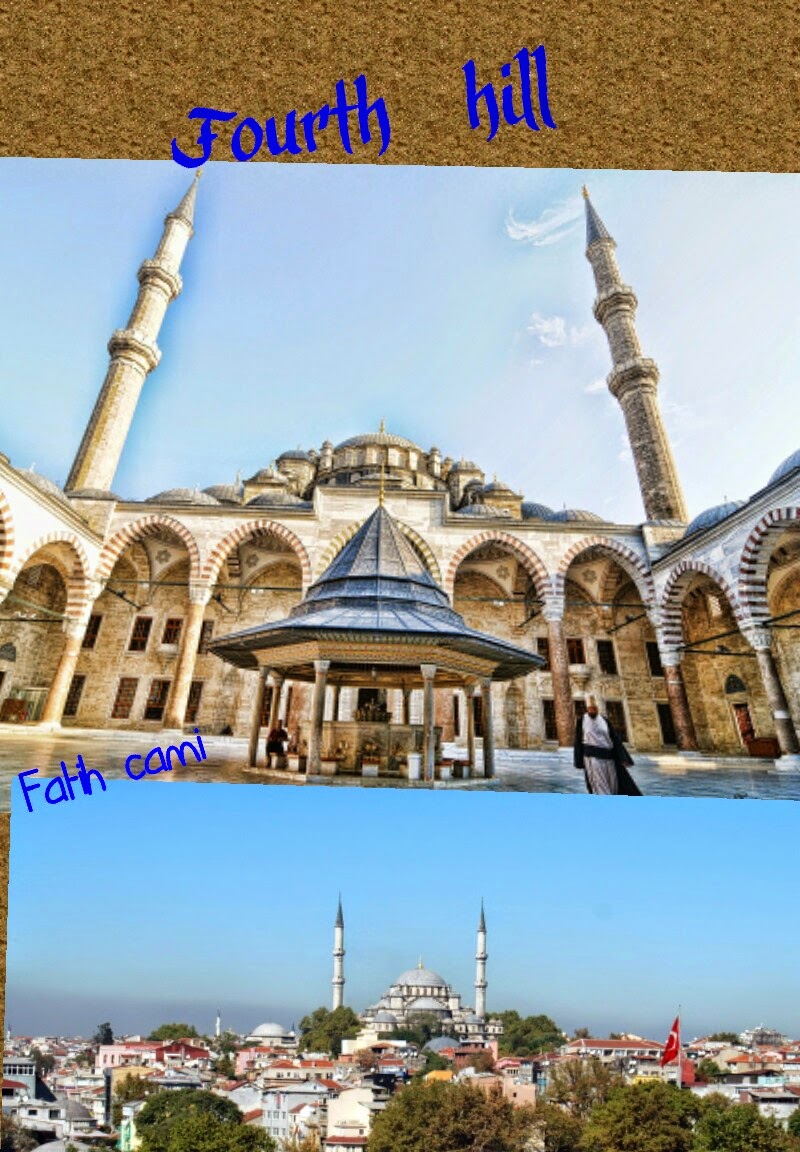
The fourth hill- Fatih hill  was one of the most prestigious. During the  Byzantine  there  stood the Church of the Holy Apostles and then  Ottoman was  the Fatih Mosque and Külliye built  there. It  slopes down rather steeply to the Golden Horn on the north and, rather more gently, to Aksaray on the south.


On the fifth hill – Yavuzselim hill  we find the Mosque of Sultan Selim. The fifth and the sixth hills are separated by the valley running down on the west to Balat on the shore of the Golden Horn.


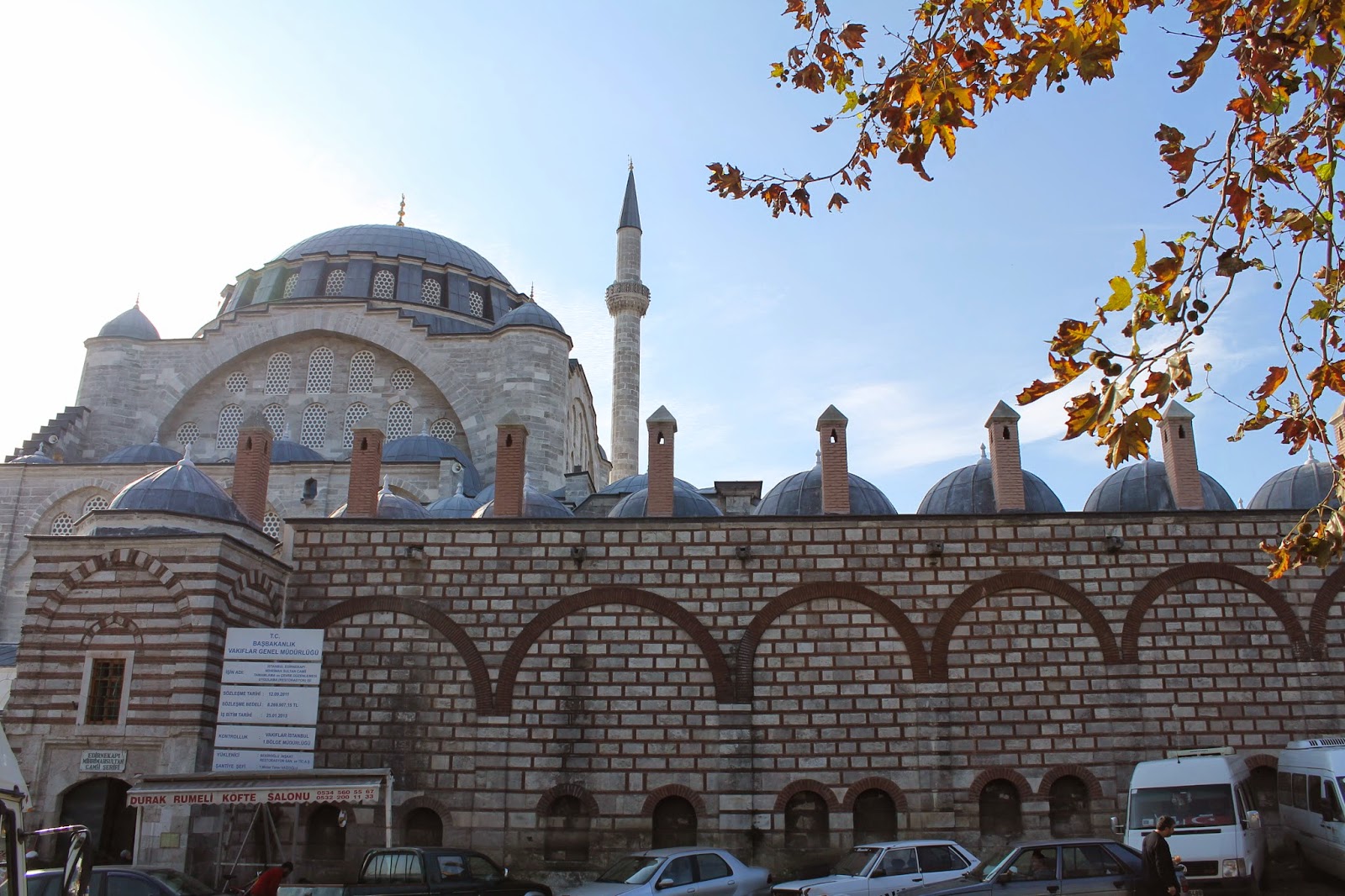
On the sixth hill – Edirnekapı hill   is highest one  from  seven hills  reaching an altitude of 70 meters.  There  are to be found the districts of Edirnekapı and Ayvansaray. Its gentle slopes run out beyond the line of thedefense walls.  We  can admire  here beautiful work of architect Sinan including Mihrimah Sultan Mosque.


The seventh hill, known in Byzantine times as the Xērolophos , or "dry hill," it extends from Aksaray to the Theodosian Walls and the Marmara. It is a broad hill with three summits producing a triangle with apices at Topkapı, Aksaray, and Yedikule. During  the  Ottoman period was  built  here the Haseki Külliye, Haseki *sultan Mosque and Bayrampaşa  too. 

štvrtok 12. marca 2015

SIDE

Side is a resort town located about 75 km east from Antalya, one of Turkey's largest  turistic cities. The resort is situated at only 800 meters long peninsula that is bordered magic pebble beaches and crystal clear sea. Modern architecture tourist resort with all the facilities which satisfy even the most demanding visitor, contrasts sharply with the ruins of the ancient center of Side. The historic core lies on a peninsula ending port. The peninsula has a length of only one kilometer, while wide is only 400 meters away. In the 1 st. p.n.l. Side was a center of pirates and slave trade. Title Side means pomegranate, which is growing around Side with oranges, grapes and cotton. Side practically one of the oldest recreation area in the world as it used to come here to bathe even Cleopatra and Mark Antony.

Side je letovisko vzdialené asi 75 km východne od Antalye, jedného z najväčších tureckých miest. Rezort sa rozkladá na iba 800 metrov dlhom polostrove, ktorý je lemovaný magickými štrkovými plážami a krištáľovo čistým morom. Moderná architektúra turistického strediska so všetkými vymoženosťami, ktoré uspokoja aj toho najnáročnejšieho návštevníka, ostro kontrastuje s zrúcaninami starovekého centra Side. Vlastné historické jadro leží na polostrove zakončené prístavom.   Poloostrov  má na dĺžku len jeden kilometer, zatiaľ čo široký je iba 400 metrov. V 1 st. p.n.l. bolo Side strediskom pirátov a obchodu s otrokmi. Názov Side znamená granátové jablko, ktoré sa v okolí Side pestujú ako aj pomaranče, grepy a bavlna.
Side prakticky patrí k najstaršej rekreačnej oblasti na svete nakoľko sa sem chodili kúpať už aj Kleopatra s Markom Antoniom.
Throughout the ancient Pamphylia Side boasted the largest port. Port influenced the history of the city. In the 1st century BC. Side has become a pirate base and center of the slave trade. Side Residents were against pirates tolerant because the activities of the pirates themselves have benefited. With the pirates finished the Roman general Pompey in 67 BC.
- Under Rome Side prospered especially in the 2nd and 3rd century AD, when it became the seat of local governors and their administrations. For a seat governors Side chosen because of the large port. Side at the time traded with the whole Mediterranean and partly with Egypt. Imported goods went forth from side to central Anatolia. The Side were then hundreds of retailers and not just on the main street, but also in old streets. The slave trade was still going on. Documents discovered in Egypt say that slaves were sending to Side mainly from Africa. Side flourished, rich people pay huge amounts for a variety of games and competitions, and many buildings.
V celej starovekej Pamfýlii sa Side pýšilo najväčším prístavom. Prístav ovplyvňoval dejiny mesta. V 1. storočia př.n.l. sa Side stalo základňou pirátov a strediskom obchodu s otrokmi. Obyvatelia Side boli voči pirátom tolerantní, pretože sami na činnosti pirátov profitovali. S pirátmi skoncoval až rímsky generál Pompey v roku 67 pnl.
- Pod rímskou nadvládou Side prosperovalo najmä v 2. a 3. storočia nl, kedy sa stalo sídlom miestnych guvernérov a ich administratívy. Za sídlo si guvernéri Side vybrali kvôli veľkému prístavu. Side v tej dobe obchodovalo s celým Stredomorím a čiastočne aj s Egyptom. Dovážaný tovar putovalo ďalej zo Side do centrálnej Anatólie. V Side boli vtedy stovky obchodov a to nielen na hlavných triedach, ale aj v tých najzapadnutejšie uličkách. Obchod s otrokmi stále pokračoval. Dokumenty objavené v Egypte hovoria, že otroci boli do Side posielaní najmä z Afriky. Side rozkvitalo, bohatí občania venovali obrovské sumy na najrôznejšie hry a súťaže a na mnoho stavieb.

- In the mid-7th century Side suffered from numerous raids by Arabs. At that time, the entire southern coast of Turkey one big war zone. Archaeological studies have revealed a layer of ash, which testifies to the fact that Arab raiders flamed  city 
 - The city was recovering, after the Arab attacks in the 12th century it has again described as large and populous city. Later, however, residents began Side leave and move to Antalya. Side thus began to say "Old Antalya".
 - V polovici 7. storočia Side trpelo početnými nájazdmi Arabov. V tej dobe bolo celé južné pobrežie Turecka jednou veľkou vojnovou zónou. Archeologické výskumy odhalili vrstvy popola, ktoré vypodvídají o tom, že arabskí nájazdníci mesto podpálili.

- Mesto sa po arabských útokoch spamätalo av 12. storočia je už opäť popisované ako veľké a lidnaté mesto. Neskôr však obyvatelia začali Side opúšťať a sťahovať sa do Antalye. Side sa tak začalo hovoriť "stará Antalye".

Witnesses of past times in the Side, are  ponds, fountains and baths, water supply system, city gates, porticos, colonnades and aqueducts. There is  beautiful view on the indispensable agora, necropolis and temples, which celebrated the god Apollo and the goddess Athena. One of the places of worship left  only a portion of the related columns;  but  this  are  typical symbol Side  and during  the  for sunrise and sunset  it  is mysterious, romantic hideaway.
Svedkami časov minulých sú v Side, napríklad vodné nádrže, fontány a kúpele, kanalizačný systém, mestské brány, stĺporadie, kolonáda a akvadukty. K videniu je tiež nepostrádateľná agora, nekropole a chrámy, ktoré oslavovali boha Apolóna a bohyni Aténe. Jeden zo svätostánkov po sebe zanechal síce už len časť prepojených stĺpov; tie sú však dnes typickým symbolom Side a za východu a západu slnka aj tajuplným, romantickým zákutiam.

Monuments
 Almost alone is here  great theater from  the 2nd century AD. Because the Side is located almost in the plane, the theater was constructed such that the lower seat are partially supported by the slope, whereas the upper row are based on  vast arch. Above the main horizontal aisle was located 29 rows of seats and below it another 29 rows. Overall, fitting it to the theater 17 thousand spectators. This was the largest theater in the whole Pamphylia. Construction of the building allowed the flood orchestra pit and play performances, which included naval battles.
Pamiatky
Takmer osamotene stojí veľké
Divadlo zo 2. storočia n.l. Pretože sa Side nachádza takmer v rovine, bolo divadlo postavené tak, že dolná sedadlá čiastočne podopiera svah, zatiaľ čo horné rady spočívajú na obrovských oblúkoch. Nad hlavnou vodorovnú uličkou sa nachádzalo 29 radov sedadiel a pod ňou ďalších 29 radov. Celkovo sa do divadla zmestilo 17-tisíc divákov. Bolo to tak najväčšie divadlo v celej Pamfýli. Konštrukcia stavby dovoľovala zaplaviť orchestriskách a hrať predstavenia, ktorých súčasťou boli námorné bitky.


In the 5th and 6th centuries, the theater was used as a church under the open sky. Place the audience is well preserved, but the stage is in ruins. It was  served as a source of building material, when the city was getting larger. For behind the teatre is  the Agora, originally surrounded on all four sides pillared colonnades. There currently ran the slave trade. In the middle stood a small Roman temple.
 V 5. a 6. storočí sa divadlo používalo ako kostol pod voľnou oblohou. Priestor pre divákov je dobre zachovaný, javisko je ale v troskách. Slúžilo totiž ako zdroj stavebného materiálu, keď sa mesto rozrastalo.
 Za divadlom je Agora, pôvodne obklopená zo všetkých štyroch strán stĺpovými kolonádami. Práve tu prebiehal obchod s otrokmi. Uprostred stával malý rímsky Chrám.

At the southernmost point of the peninsula were built two temples, the ruins of which are still preserved. Because the patron goddess of Side was Athena, was one of those temple dedicated to this goddess of law. Athena used to be the patron saint of seafarers and port. The Second Temple was dedicated to Apolon. Both temples come from the 2nd half of the 2nd century AD. In the 5th century, was in front of the temples built  the great basilica. By  the  time was the temples severely damaged. Temple of Apollo is reconstructed. Right from this temple we can see breathtaking sunsets. 


Na najjužnejšom bode polostrova boli postavené dva chrámy, ktorých ruiny sa dodnes zachovali. Pretože patrónkou Side bola bohyňa Aténa, bol jeden z týchto chrámu zasvätený práve tejto bohyni. Aténa bývala patrónkou prístavov a námorníkov. Druhý chrám bol zasvätený Apolónovi. Oba chrámy pochádzajú z 2. polovice 2. storočia n.l. V 5. storočia bola pred chrámami postavená veľká bazilika. Časom boli všetky chrámy značne poškodené. Apollonov chrám sa rekonštruuje. Práve od tohto chrámu sa naskytujú úchvatné západy Slnka.

Residents Side was  supplying with  water from the river Melas, today called Manavgat. Water from the River Side was transported by the  length of 30 km storey aqueduct. Water fed into Nymfaio (nymfeum, also nymfaion = ornamental fountain dedicated to the nymphs), which was located near the main gate. Earthen pipeline water flowedfrom the tanks of urban into households. There are  well preserved Hellenistic city walls with impressive city gate entrance with two towers. The statues that once graced these towers, can now be seen in the local museum.
Obyvatelia Side bývali zásobovaní vodu z rieky Melas, dnes sa volá Manavgat. Vodu z tejto rieky do Side dopravoval v dĺžke 30 kilometrov dvojposchodový
akvadut. Vodu privádzal do nymfea (nymfeum, tiež nymfaion = okrasná fontána zasvätená nymfám), ktoré sa nachádzalo v blízkosti hlavnej brány. Hlineným potrubím potom voda pritekala z mestských cisterien do domácností.
Dobre sa zachovali helenistickej mestské
hradby s impozantnou vstupnou mestskou bránou s dvoma vežami. Sochy, ktoré kedysi tieto veže zdobili, je dnes možné vidieť v tunajšom múzeu.

The museum is housed in the building of Roman baths. These baths were the largest of the original three public baths in Side. The dimensions was  40 x 50 meters and were built in the 3rd century AD. In the museum are seen marble sculptures, set of agricultural implements and utility vessels, sarcophagi with beautiful reliefs, bronze hand that bore the flaming torch, small statues, such as a house with a dog curiously looking from  doors, etc. is remarkable marble head messenger of the gods Hermes and torsos three Graces. At the building complex is a beautiful garden, where it is collected of temples that were found


Múzeum sa nachádza v budove bývalých rímskych kúpeľov. Tieto kúpele boli najväčší z pôvodne troch verejných kúpeľov v Side. Mali rozmery 40 x 50 metrov a vybudované boli v 3. storočia n.l. V múzeu sú k videniu mramorové sochy, súbor poľnohospodárskeho náčinia a úžitkových nádob, sarkofágy s krásnymi reliéfmi, bronzová ruka, ktorá niesla horiacu pochodeň, malé sošky, napríklad dom so psom zvedavo vykukujícícm z dverí, atď Pozoruhodná je mramorová hlava posla bohov Herma a torzá troch Grácií. Ku komplexu budov patrí krásna záhrada, kde sú zhromaždené časti chrámov, ktoré boli nájdené 


streda 11. februára 2015

Istanbulun camileri .... Mosques of Istanbul ..... Istanbulské mešity


 Eyup  cami


Fatih  cami


 Laleli  cami


Mihrimah  cami   Edirne  kapıda


Örtakoy  cami


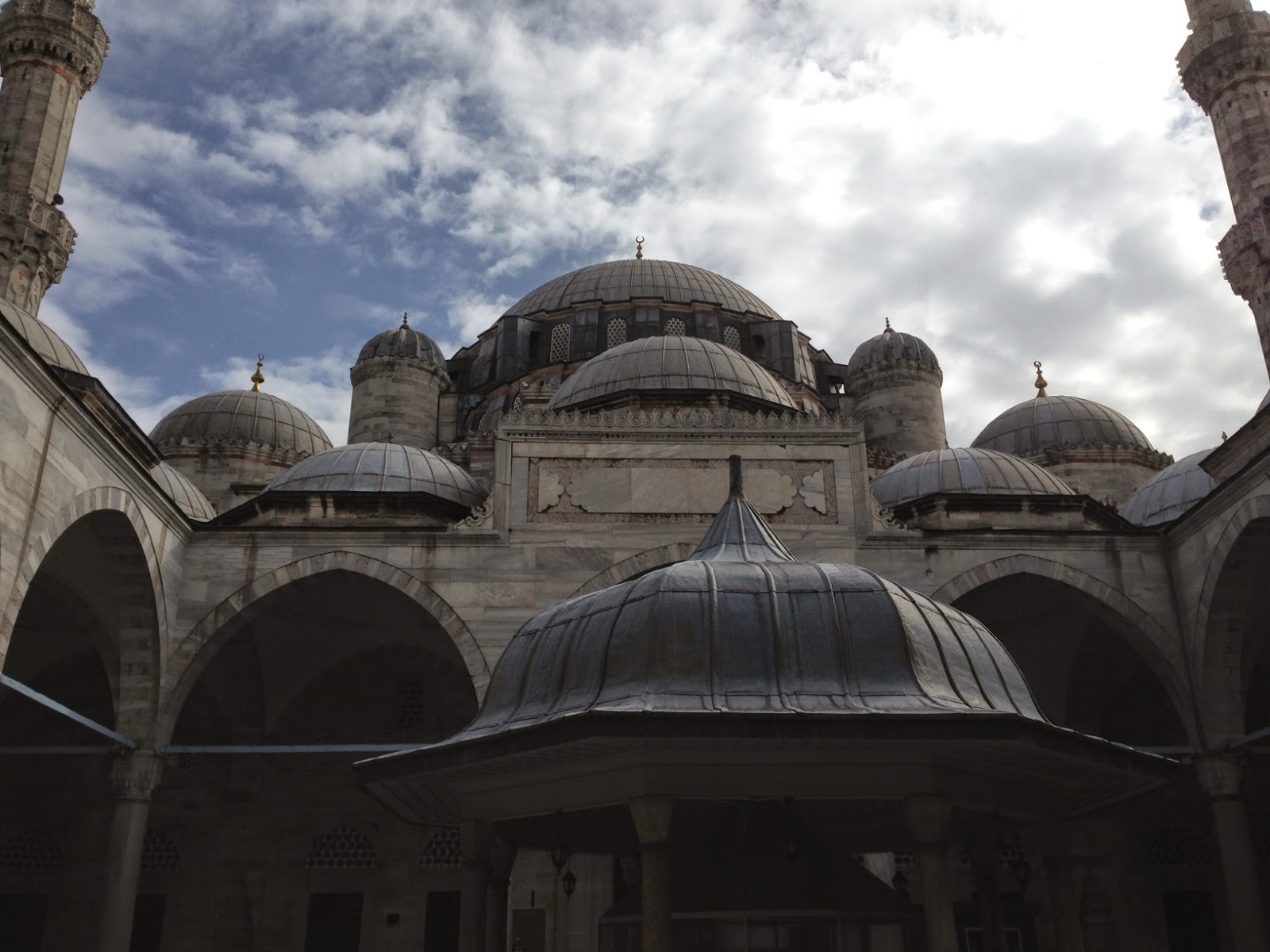
 Sehezade  cami


 Sülejmaniye  cami


 Sultan Ahmed  cami
 Yeni  cami